Datalogic Blade Compact Industrial 1D Reader
Brand - Datalogic
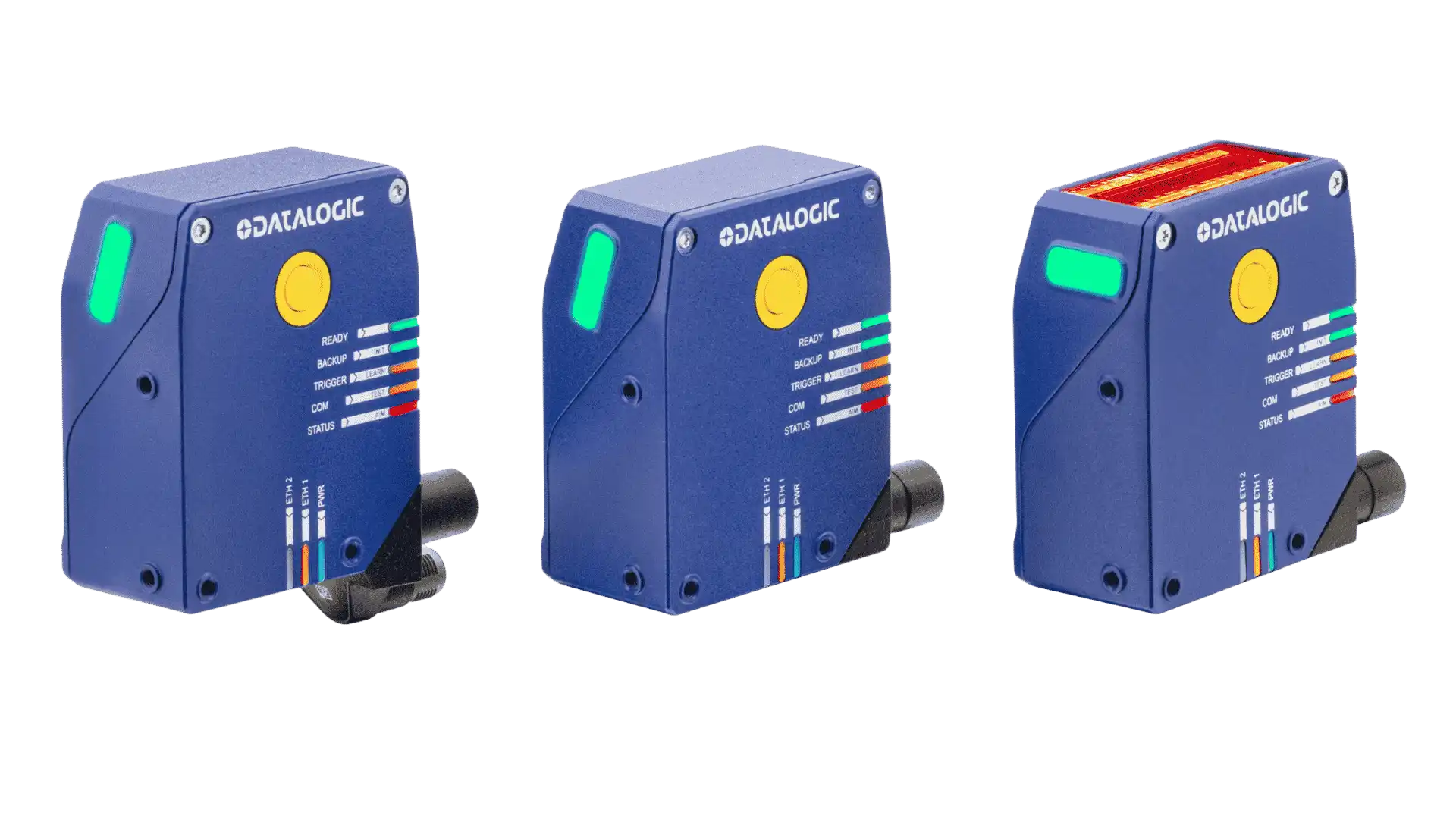
The Datalogic Blade is a compact fixed-mount industrial 1D reader designed for automatic warehouses, intralogistics, factory automation, tote routing, automatic picking systems, process control, packaging traceability, print & apply systems and end-of-line sorting applications. The Blade series represents a new generation of compact industrial 1D readers. It is designed as the evolution of the Datalogic DS2x00 laser scanner family, but with a major technology change: Blade uses imaging technology instead of laser scanning. This means no laser and no moving parts, helping improve reliability and reduce maintenance. Although Blade uses a camera sensor, it should be positioned as an industrial 1D reader, not as a general-purpose 2D code reader. It is designed for 1D barcode traceability applications where linear codes are used. It should not be selected for QR Code, Data Matrix, DPM or image-inspection tasks unless another suitable Datalogic 2D imager is specified. A key advantage of the Blade platform is the power of imaging. The reader uses a 2000 x 128 pixel camera sensor and an innovative lighting system to improve reading reliability and performance on poor-quality labels. This makes it suitable for real-world industrial environments where labels may be damaged, poorly printed, wrinkled or affected by packaging conditions. Blade is designed for lean integration. Its small size, multiple fixing points and embedded flexibility allow installation in different positions and orientations. It supports various mechanical installation needs in OEM machines, conveyors, packaging lines and intralogistics systems. A major benefit is smooth migration from DS2x00 scanners. Blade is designed to be mechanically compatible in terms of dimensions, positioning and reading coverage with DS2x00 installations. This makes it a practical upgrade path where customers want to move from laser-based 1D readers to a more reliable imaging-based platform without redesigning the complete machine layout. Blade is built around a simple “Fix-Plug-Go” installation concept. “Fix” means the reader can be mounted in the required position or angle using multiple fixing points. “Plug” refers to M12 connectors for both I/O and networking. “Go” highlights that the device is ready to start after power-up without requiring image calibration. The Blade series is configured through DL.CODE, the standard configuration tool used for Datalogic Matrix Series readers. This provides a modern setup environment and helps standardize configuration across Datalogic industrial identification devices. Blade is available in two product versions: Blade 100 and Blade 200. These versions provide different reading power and flexibility levels, allowing users to match the device to the application requirements. Blade 100 is suitable for compact short- to medium-range 1D reading applications where reading distances from 40 to 320 mm are required. It is a good fit for controlled automation points, packaging lines and close-range traceability applications. Blade 200 is designed for applications requiring a longer reading distance, from 40 to 600 mm. It is the stronger option where labels pass at a greater distance from the reader or where installation geometry requires more reading flexibility. Both Blade 100 and Blade 200 support a maximum resolution up to 0.1 mm / 3.94 mils. The frame rate is 270 frames per second, and the aperture angle is 47 degrees. This supports fast industrial reading while maintaining the advantages of solid-state imaging technology. Supported readable codes include Interleaved 2 of 5, Code 39, Code 93, Code 128, EAN / UPC, GS1-128 / EAN 128, Codabar, Pharmacode, Plessey and ISBT128. These are classic 1D symbologies used in logistics, packaging and manufacturing traceability. The mechanical design is compact and industrial. Blade uses an aluminum housing and has typical dimensions of 104 x 68.5 x 38.5 mm or 104 x 86 x 38.5 mm, depending on model and connector configuration. Weight is 310 g. The reader is rated IP65 and operates from 0°C to 50°C. Power supply is 10–30 VDC. Maximum power consumption is listed as 4.5 W for Blade 100 and 5.5 W for Blade 200, depending on model configuration. Connectivity options are designed for industrial automation environments. Available options include single-port Ethernet TCP/IP with legacy RS-232, dual-port PROFINET and dual-port EtherNet/IP. This allows Blade to fit different control architectures and fieldbus requirements. The Blade -X1XX models include Ethernet TCP/IP, main RS-232 and auxiliary RS-232 communication. Blade 200 -X1XX models additionally list RS-422 / RS-485 on the main port. These versions are suitable where standard Ethernet and serial integration are required. The -X2XX and -X3XX models provide dual-port industrial Ethernet options. The -X2XX versions support dual-port EtherNet/IP, while the -X3XX versions support dual-port PROFINET, conformance Class B. These versions are better suited to modern automation systems where fieldbus communication and network topology are important. Digital I/O depends on model version. Some models provide two optocoupled NPN / PNP inputs, while dual-port fieldbus versions list one optocoupled input. Digital outputs include two outputs. ID-NET is supported, and Xpress Interface is listed as part of the platform. Maintenance reduction is a major part of the Blade value proposition. Because Blade eliminates moving parts and uses full electronic imaging components, it is designed to improve product lifetime and reduce total cost of ownership compared with mechanical laser scanning systems. Replacement and service workflows are also supported. Configuration backup and restore are available both over the network and locally through the new MicroSD card slot. This helps reduce downtime when a device must be replaced. Monitoring options include embedded WebMonitor, similar to the Matrix Series, which is freely accessible. Blade can also connect to the WebSentinel Plus ecosystem for broader monitoring and traceability supervision. Typical sub-industry targets are packaging and intralogistics. In packaging, Blade is relevant for pharma, food and beverage, primary and secondary packaging traceability, print & apply verification and end-of-line sorting. In intralogistics, it supports tote routing, warehouse automation and general material flow identification. Overall, the Datalogic Blade is a compact imaging-based industrial 1D reader for applications that need the reliability of solid-state imaging but still use linear barcodes. Its strongest value lies in the DS2x00 migration path, compact aluminum housing, no moving parts, 2000 x 128 pixel sensor, innovative lighting, 270 fps frame rate, up to 600 mm reading distance on Blade 200, strong performance on poor-quality labels, DL.CODE configuration, M12 connectivity, Ethernet / PROFINET / EtherNet/IP options, MicroSD backup and restore, WebMonitor and WebSentinel Plus monitoring support.
Product Identifiers
| Device - SKU | Description |
|---|---|
| 930190002 | BLADE 100 1100 ETH FRONT |
| 930190003 | BLADE 100 1101 ETH SIDE |
| 930190004 | BLADE 100 1201 ETH-IP SIDE |
| 930190005 | BLADE 100 1301 PNET SIDE |
| 930190001 | BLADE 100 2100 HI-RES ETH FRONT |
| 930190007 | BLADE 200 1100 ETH FRONT |
| 930190008 | BLADE 200 1101 ETH SIDE |
| 930190009 | BLADE 200 1200 ETH-IP FRONT |
| 930190010 | BLADE 200 1201 ETH-IP SIDE |
| 930190011 | BLADE 200 1300 PNET FRONT |
| 930190012 | BLADE 200 1301 PNET SIDE |
Have questions about this product, or need additional technical information, configuration details or a quotation? Contact us – our team will be happy to assist you.